Shadowing Practice (Three Stages + Recording)
Three-stage shadowing: passive listen → shadow with text → blind shadow. With in-browser recording for self-comparison.
📘 How to use Shadowing
Walk through the three stages, toolbar toggles, and the workflow that actually trains your ear.
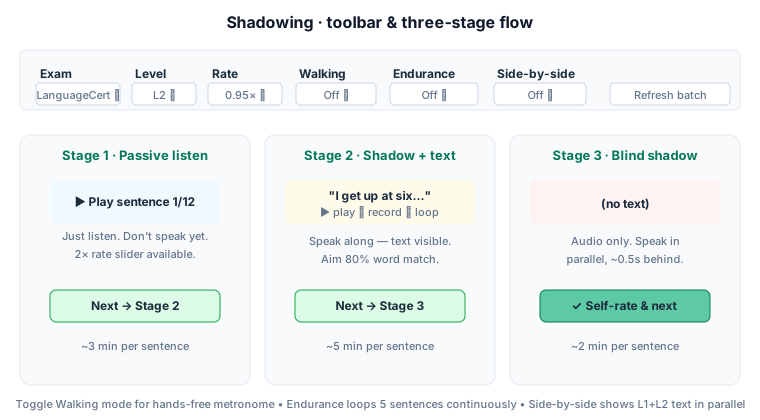
Toolbar reference
| Toolbar control | What it does · recommendation |
|---|---|
| Exam · Level | Narrows the pool to one exam + level (L1 / L2 / L3). Start one level below your reading ability. |
| Rate | 0.5×–1.5×. First pass on a new sentence at 0.7×; 0.85×–1.0× once familiar. |
| Walking | Off / On. Pulse indicator times your steps — shadow while walking, hands-free. The single most useful toggle. |
| Endurance | Off / 3 / 5 / 7 sentences. Auto-loops N sentences in sequence without you tapping Next. Use 5 for daily training. |
| Side-by-side | Off / On. Shows L1 gloss next to L2 when text is visible. Use first 2 weeks; turn off by week 3. |
| Material | Teaching examples vs Authentic (CC-BY Wikipedia). Switch to Authentic at L3. |
Step-by-step workflow
- Stage 1 · Passive listen — Play 2–3 times. Don't speak. Goal: catch rhythm, stress, connected speech. If you can hum the prosody, advance.
- Stage 2 · Shadow with text — Audio plays continuously, you speak half a second behind. Text is a checkpoint — glance, then close your eyes.
- Stage 3 · Blind shadow — Audio only. Speak in parallel, ~0.5 s lag. Lag a full second = you've stopped shadowing; restart the sentence.
- ✓ Self-rate + next — ✗ Hard / ◐ Got it / ✓ Easy writes to SRS — be honest.
Common mistakes
- Quitting after day 2. The brain needs 5–8 days to stop reaching for L1 during shadowing. Day 1–4 discomfort is the method working.
- Picking the highest Diff too early. Shadowing trains reflex, not understanding — set Diff one level below your reading ability.
- Sitting still in front of a screen. Turn on Walking mode — focus comes back instantly.
Want to see how the 4 tools combine into a 30-day routine? Read the full hands-on guide.
→ Read the full guideFrequently asked questions
Will shadowing make my accent more native-like?
Shadowing trains pronunciation, intonation, and connected-speech rhythm — measurable gains are typical within 4–6 weeks of daily 15-minute sessions. It will not erase a regional accent; it will significantly reduce the second-language stiffness that comes from word-by-word output. The bigger gains are in fluency continuity, not accent neutralisation.
How long should one shadowing session be?
For untrained ears, 10 minutes is the productive ceiling — beyond that, attention degrades and you start parroting without parsing. Aim for two 15-minute sessions per day rather than one 30-minute block. After 6 weeks, productive session length can extend to 25 minutes.
Do I need to understand every word before I shadow?
No. Arguelles' original protocol recommends shadowing material slightly above your comprehension level so the pronunciation system stays under load while meaning emerges through repetition. If you understand 100% on the first pass, shadow that material at 1.25× speed; if you understand 0%, drop to 0.7× and pre-read first.
Why does Walking mode work?
Locomotor rhythm syncs with speech rhythm — the gait pulse acts as an external metronome that prevents the unnatural pauses learners insert when they search for words. Empirically (FSI / DLI internal observations) walking shadowers reach the intelligible-at-native-pace milestone about 30% faster than seated shadowers.
When should I switch from Teaching examples to Authentic material?
When the Teaching examples at your Level 3 feel too slow and over-articulated — usually 4–8 weeks of daily practice. Authentic material (Wikipedia narration, news clips) loses the careful pacing but gains real-world prosody. Switch gradually: alternate Teaching and Authentic in the same session for 2 weeks before going fully Authentic.