Scriptorium Listen-Read-Write Method
Arguelles's four-step intensive method: listen → read aloud → dictation → compare → re-read. Trains four skills in parallel.
📘 How to use Scriptorium
Arguelles' 5-step intensive protocol, and the three gates that make it stick.
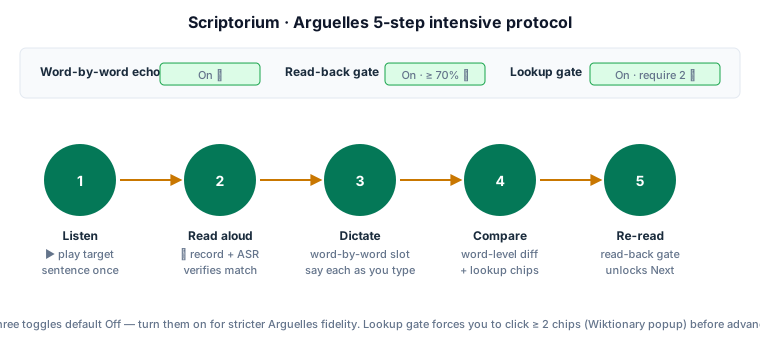
Toolbar reference
| Toolbar control | What it does · recommendation |
|---|---|
| Word-by-word echo | Off / On. Step 3 (dictate) becomes a typed-slot interface where you must say each word as you write it — Arguelles' original spec. |
| Read-back gate | Off / On (≥ 70%). You must read your written version back to ASR before Step 4 (compare). Catches the mental-checkmark cheat. |
| Lookup gate | Off / On. Step 4 shows a chip grid of long words; you must click N chips to open Wiktionary popups before Step 5 unlocks. N = max(1, ceil(words/5)). |
| Material | Teaching examples vs Authentic. Switch to Authentic once you're past intermediate. |
Step-by-step workflow
- 1 · Listen — ▶ once. Hear the target sentence.
- 2 · Read aloud — Speak it back. ASR ≥ 70% unlocks Step 3.
- 3 · Dictate — Type the sentence word by word from memory. With Word-by-word echo on, each slot waits for the spoken word.
- 4 · Compare — Word-level diff (green ok / red strikethrough missed / orange [+] inserted) + lookup chip grid. Click chips for words you didn't know.
- 5 · Re-read — Read the original sentence aloud once more — now knowing every word.
Common mistakes
- Turning all three gates off. Word-by-word echo + Read-back + Lookup all on = the Arguelles protocol. The gates exist to stop you cheating.
- Peeking at the target during dictation. The whole point is forcing your ear ↔ spelling connection in your head. Peeking ruins the exercise.
- Clicking the easiest words for Lookup. The gate is there for words you don't know — click those, not the comfortable ones.
Want to see how the 4 tools combine into a 30-day routine? Read the full hands-on guide.
→ Read the full guideFrequently asked questions
What is Arguelles' Scriptorium method?
A 5-step intensive protocol: 1) read a sentence aloud, 2) write it word-by-word while saying each word out loud, 3) read aloud what you've written, 4) look up any word you didn't fully understand, 5) move to the next sentence. The technique synchronises listening, reading, speaking and writing on a single small chunk of language.
Why write by hand if typing is faster?
Handwriting forces a slower, more deliberate engagement with each word's spelling and form. Cognitive-science studies on note-taking consistently find better retention after handwritten input vs typed input. For Scriptorium specifically, the goal is depth — typing is too automatic to produce the deep encoding the method wants.
What is the look-up-unknown-words gate?
Step 4 of the protocol. You are not allowed to advance to the next sentence until you have actually looked up any word you could not fully define. The gate exists because skipping unknowns is what differentiates intensive reading (deep, transformative) from extensive reading (broad, surface). Scriptorium without the lookup gate is just slow reading.
How many sentences should one Scriptorium session cover?
5–8 sentences in 30 minutes is a realistic pace at B1/B2. At C1 with denser material, 3–4 sentences may take the full session. Quality of completion (every word said, every gap looked up, every sentence re-read) matters infinitely more than volume.
Can I use Scriptorium with audio material instead of written text?
Yes — listen, transcribe what you hear, then run the standard 5 steps on your transcription. This combined version is heavier (you transcribe under listening pressure first) and is what DLI calls active listening transcription. Recommended only after 4+ weeks of standard Scriptorium proficiency.