FSI Mim-Mem Practice (Dialogue Memorization)
Mimicry-memorization: blind listen → backward build-up → snowball → cold recall. The FSI Basic Course speaking core, in your browser.
📘 How to use Mim-Mem
Five steps from blind listen to full recall, plus the toggles that turn this tool into FSI-faithful Mim-Mem.
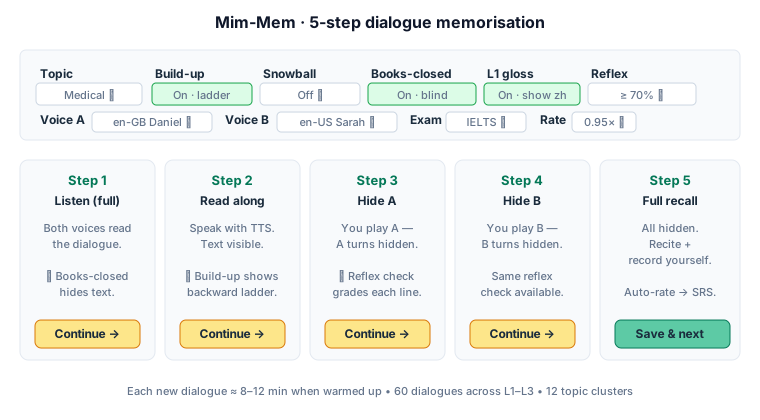
Toolbar reference
| Toolbar control | What it does · recommendation |
|---|---|
| Topic | Filter the 60-dialogue library by cluster (food / transit / medical / work / finance / policy …). Job interview next week? Set Topic = work. |
| Build-up | Off / On. Long lines render as a backward ladder — the FSI technique most YouTube tutorials skip. Use on any line ≥ 7 words. |
| Snowball | Off / On. Step 2 advances turn by turn with cumulative recitation (Stevick's snowball). Leave off your first week. |
| Books-closed | Off / On. Whether Step 1 hides the dialogue text. FSI's books-closed first listen is non-negotiable — turn this on day one. |
| L1 gloss | Off / On. Shows native-language gloss under visible turns. Use first 2 dialogues of any new topic, then off. |
| Reflex | Off / On (≥ 70%) / Strict (≥ 85%) / Easy (≥ 55%). 🎙 button next to each hidden turn grades you via browser ASR. |
| Voice A · B | Two TTS voices for the two speakers. Pin to your favourite pair and stop fiddling. |
Step-by-step workflow
- Step 1 · Listen (full) — Both TTS voices read the full dialogue. With Books-closed on, only ▶ Play is visible. Play twice. No looking, no speaking.
- Step 2 · Read along — Text appears. Speak along with TTS. With Build-up on, long lines render as ladders — ▶ Play ladder plays each rung twice automatically.
- Step 3 · Hide A — A's lines become '(your line — speak it)'. TTS plays B; you speak A. Reflex on → 🎙 grades you.
- Step 4 · Hide B — Roles swap.
- Step 5 · Full recall — All hidden. Recite the entire dialogue from memory. If Reflex collected ratios, auto-writes a 1–3 ★ SRS quality.
Common mistakes
- Skipping Step 1. 'I can read, I'll jump to Step 2' — wrong. Step 1's blind listen is what installs the rhythm.
- Turning off Books-closed. Once you see 'rentre' before hearing it, your brain pronounces it with spelling-pronunciation forever.
- Doing one dialogue eight times in a session. The point is over-learning across days, not over-saturation in one sitting. FSI rate ≈ one new dialogue every 3 days.
Want to see how the 4 tools combine into a 30-day routine? Read the full hands-on guide.
→ Read the full guideFrequently asked questions
Why is books-closed essential on the first pass?
Reading and listening engage different neural pathways. If your eyes lead, the ear stops working — you'll lock the rhythm of how the line is written instead of how it's said. FSI made books-closed first-listen mandatory after observing that students who read along on Day 1 plateaued at a measurably lower fluency ceiling.
How many dialogues should I memorise per week?
Two to three at Level 1, one to two at Level 2, one at Level 3. The goal is full recall — saying the whole dialogue from memory with native pace and intonation. Faster turnover (5+ per week) almost always produces shallow surface memorisation that decays in days. Quality of recall beats dialogue count by a factor of ten.
What is cumulative recitation (Stevick's snowball)?
After memorising line A, recite A + B together. After B, recite A + B + C. By the time you reach line 10, you've spoken line 1 ten times. The progressive load is how short-term memorisation transfers to long-term — the same principle that makes spaced repetition work, applied at conversational-chunk level.
When should I turn off L1 gloss?
After the first two dialogues of any new topic cluster. The gloss is a comprehension scaffold, not a learning aid — once you've internalised the topic vocabulary, leaving the gloss visible slows down the L2-only retrieval that real conversation demands. By dialogue 3 in a cluster, native-only recall should be the goal.
Will the ASR Reflex mode work with my accent?
Browser ASR (Chrome / Edge SpeechRecognition) is trained on a broad accent corpus and handles most Indian, Chinese, Spanish, Arabic and East Asian-accented English at conversational pace. Heavy regional accents that distort vowels may trigger false negatives; if ASR consistently rejects you despite clear pronunciation, switch to manual reflex (recordings reviewed by yourself).